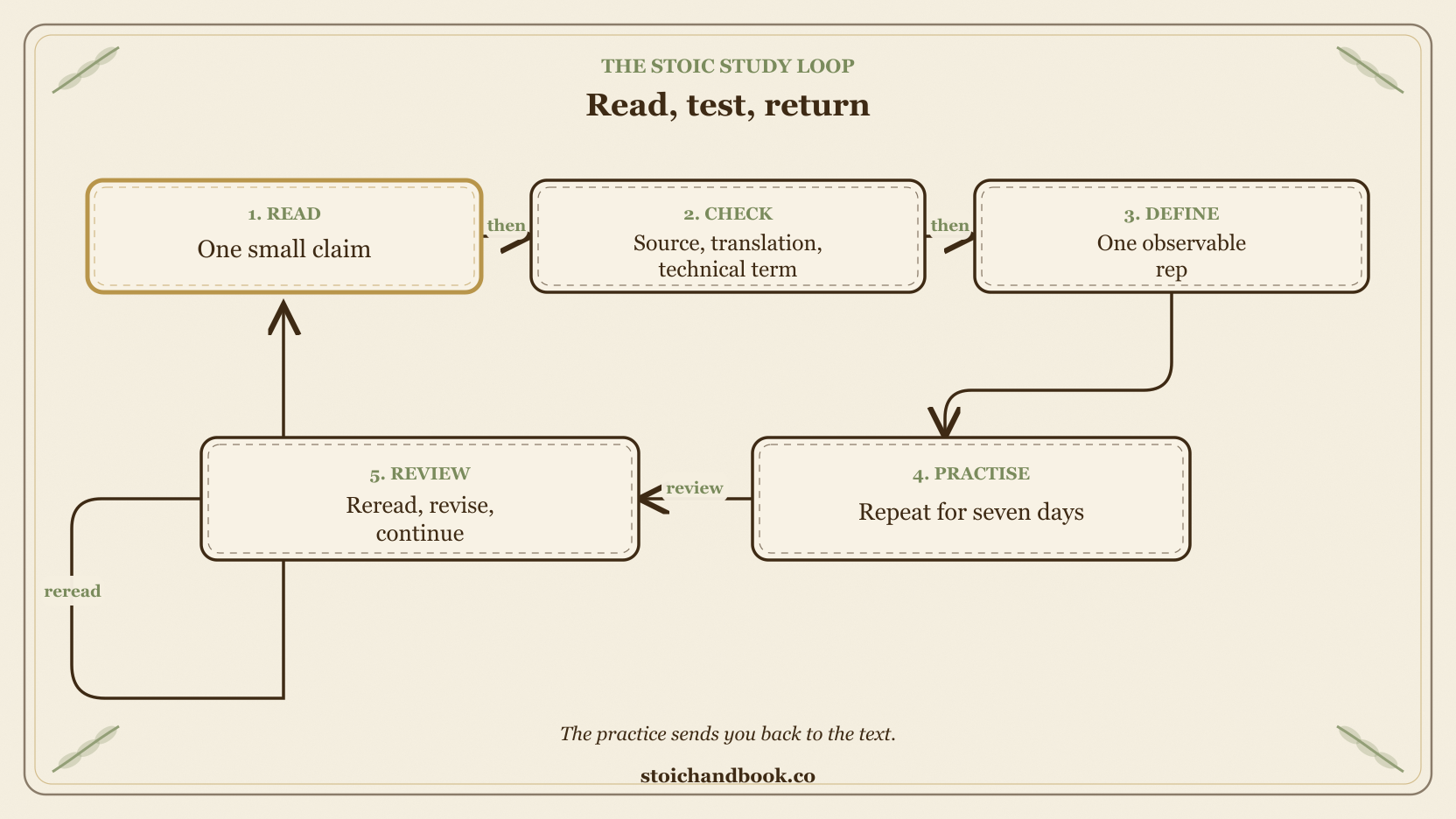
To study Stoicism, do not set yourself a target number of pages. Pick one claim, check what the ancient text actually says, turn it into one action you can observe, practise it for a week, and review what happened. Then return to the passage.
That is the short answer. The rest of this guide shows you how to do it without turning Stoicism into a collection of quotes or a performance of being well read.
I learned this lesson twice.
At eighteen, I had just started film school and assumed that loving films meant I understood how to make them. Then I read Robert McKee's Story. Within a few days I could talk about inciting incidents, subplots and the hero's journey. My classmates started treating me as “the scriptwriting guy.”
I had acquired a vocabulary. I had not acquired the craft.
Years later, Brazilian jiu-jitsu made the difference impossible to miss. Watching a world-class technique can show you what is possible. It cannot give you the timing, sensitivity or judgement required to use it against another person who is resisting. That part arrives through drilling, failure, correction and another attempt.
Stoic reading works the same way. The book supplies material for practice. Finishing the book is not the practice.
Reading is preparation, not proof of progress
Epictetus makes this argument directly in Discourses 1.4. A student points to the books he has read. Epictetus compares him to an athlete who displays his training weights when asked to show the effect of training:
“What I want to see isn't the weights but how you've profited from using them.”
His target is not reading. He taught through texts, arguments and discussion. His target is the substitution: treating your ability to explain a principle as evidence that the principle has changed you.
The test is conduct. Did you catch the judgement before sending the message? Did you keep the promise when it became inconvenient? Did you distinguish what was yours to choose from what belonged to chance or another person?
This is also why the Enchiridion can be misleading when approached as a reading challenge. It has 53 short sections and can be finished quickly. But it is a digest of Epictetus's teaching, not a claim that wisdom can be acquired in an hour. Its brevity makes it portable. It does not make it shallow.
The five-step Stoic study loop
1. Read one small claim
Choose a paragraph, a short section or one argument. Stop before the text becomes a blur.
“Read less” is not a moral rule. It is a way of giving one idea enough room to meet your life. You can always continue when the first piece has produced a useful question or action.
2. Check the source, translation and term
Ask three things:
- What text is this actually from?
- Which translation am I reading?
- Is a technical term carrying more meaning than the English word suggests?
This prevents the common slide from an ancient claim to a modern slogan. For example, Epictetus's prohairesis is often flattened into “control,” but it points more precisely to the faculty of choice or volition. The guide to prohairesis shows why that distinction changes the practice.
When a quotation is doing most of the work, check its wording and provenance. The Stoic Quote Source Audit exists for exactly this reason.
3. Convert the claim into one observable rep
“Be more Stoic” cannot be practised because you cannot see yourself doing it.
Make the action smaller and visible:
- Before one difficult email, write down what is yours to choose and what is not.
- Before one meeting, rehearse the kind of colleague you intend to be.
- When one strong impression arrives, name the claim it is making before you agree with it.
- At night, review one event and identify one better response for tomorrow.
The Stoic Practice Lab contains more exercises, but one rep is enough for a reading session.
4. Practise it long enough to produce evidence
Justin Noppé's learning work gave me a useful way to describe the usual failure:
“Biggest mistake is the lack of chunking. People try to execute on chunks of information, data, exercises, etc. that are currently too big for them, too much of a stretch.”
His proposed correction is “micro changes tracked over time.”
For Stoic study, that means resisting the urge to install an entire philosophy on Monday. Choose one behaviour and count the opportunities to practise it. If the rep rarely happens, make it smaller or attach it to a clearer trigger.
The modern learning language is Justin's. The ancient standard remains Epictetus's: show the effect of the training in how you judge and act.
5. Review, reread and revise
At the end of the week, return to the passage and ask:
- Where did I remember it without prompting?
- Where did I remember only after the event?
- What did the text seem to promise that the practice did not deliver?
- Did I misunderstand the claim, choose a rep that was too large, or avoid the situations that would test it?
- What is the next smaller or more honest experiment?
Rereading after practice is different from rereading immediately. You now have something to bring back to the text: examples, resistance, awkward exceptions and evidence that your first interpretation may have been too neat.
A seven-day reading-to-practice experiment
Use this with a section of the Enchiridion, a passage from the Discourses, one of Seneca's letters or a short entry in the Meditations.
Day 1: choose the passage
Write its source and translation. Summarise its claim in one sentence without copying the author's words.
Day 2: name the situation
Choose one recurring situation where the claim matters. Make it specific: the first work message of the day, the school run, the moment you open social media, or the conversation you keep postponing.
Day 3: define the smallest rep
Write an action that takes less than two minutes. A pause, a two-column note, one question or one sentence may be enough.
Days 4–6: repeat and record
Use a tally, not an essay. Record the opportunity, whether you remembered, what you did and one sentence about the result.
Day 7: review and reread
Read the original passage again. Keep, shrink, change or discard the rep based on what happened. The point is not to protect the exercise from failure. The point is to learn what the idea can actually do.
Four traps that make Stoic reading feel productive
Counting books
A long completed list can be satisfying while telling you nothing about judgement or conduct. Seneca's Moral Letters 2 warns against hurriedly visiting many authors without becoming acquainted with any of them. The problem is not quantity by itself. It is leaving before anything has been digested.
Harvesting quotations without context
A sentence can be memorable and still be mistranslated, detached from its argument or not Stoic at all. Save the source, section and translation with the line. If you cannot find them, label the quotation as unverified rather than lending it an ancient name.
Treating notes as a second library
A vault full of highlights can reproduce the same problem as a shelf full of unread books. Keep a practice note instead:
| Field | Question |
|---|---|
| Passage | What exact text am I working with? |
| Claim | What does it ask me to understand or do? |
| Situation | Where will life test it? |
| Evidence | What happened when I tried? |
The Stoics did keep precepts “ready to hand.” The point was availability under pressure, not the size of the collection. This guide was checked against the Stoic Codex note on Maxims Ready-to-Hand, along with its source trail through Epictetus.
Turning the method into another performance
You can become proud of practising slowly, keeping perfect notes or running a seven-day experiment. That is the same mistake in new clothes. The evidence is still how you meet the next event.
What should you read first?
There is no single correct order, but the text should match the job.
- Read the Enchiridion for a compact set of precepts, then use the Discourses to recover the arguments and teaching situations behind them.
- Read the Meditations as a private practice notebook, not a systematic introduction to Stoicism. The guide to the Meditations explains its structure and limitations.
- Read Seneca's letters when you want to follow an ethical problem in a conversational form. Stay with one letter long enough to test its advice.
- Use a responsible modern commentary to clarify context, then return to the primary text rather than replacing it.
One primary text and one good companion are enough. The next book can wait until the current one has generated a real question your present sources cannot answer.
Frequently asked questions
How do I study Stoicism as a beginner?
Start with one short primary passage and one recurring situation in your life. Check the source and translation, turn the claim into a small action, practise it for seven days and reread the passage with your notes.
Do I need to finish the Enchiridion?
No. It is useful to understand its overall shape, but finishing all 53 sections is not evidence that you can use them. A small section practised honestly is a better starting point than a fast completion.
How many Stoic books should I read at once?
Usually one primary text and one commentary are enough. Add another source when it answers a real interpretive problem, not because your reading list feels too short.
How do I remember what I read?
Connect one claim to a recurring trigger, practise one observable response and review it. Memory becomes more useful when the idea is repeatedly retrieved in the situation where it matters.
How do I know whether Stoicism is changing me?
Look for behavioural evidence: a judgement caught earlier, a promise kept, a calmer correction, a boundary stated clearly or a faster recovery after failure. The standard is not whether you can explain the doctrine beautifully.
If you want to test this method with a guided sequence, the free 7-Day Stoic Challenge gives you one short lesson and one exercise each day.
Sources and method
The ancient reading-and-practice claims were checked through The Stoic Codex before drafting, including Figures/Epictetus.md, Concepts/Maxims Ready-to-Hand.md, Concepts/The Sage and Moral Progress.md and Maps/Practices MOC.md, then checked against the underlying texts.
- Epictetus, Discourses 1.4, “On progress, or moral advance”
- Seneca, Moral Letters 2, “On discursiveness in reading”
- Justin Noppé, direct contribution by email, 31 July 2026; linked above to the learning series he requested.
Read one thing. Test one thing. Bring the result back to the text.